Life After College

Chapter 17 of my memoir, work in progress….

I consider that my post-college phase officially began after the teaching internship at St. Paul’s School, in the late summer/fall of 1983. Since I knew that I had the internship in hand during the remainder of my spring semester at Hampshire College, I really didn’t worry about what would happen after it ended. Again, I just hoped that something magical would transpire to take me to the next step.

In reality, I landed with a thud, and a frightening one at that. I was fortunate to have family in the area – in particular, my Aunt Emily and Uncle Bill, who lived in West Newton, a suburb outside of Boston. Uncle Bill was my mom’s younger brother – the one who went to Harvard, was a Baker Scholar at Harvard B-School, and was then a successful corporate gypsy in the oil industry. He started out in the Philippines, before grad school, working for Chemical Bank. After the two-year stint in business school, he moved to London to work for Conoco. After a few years in the UK, the oil giant sent him and his family packing to Hamburg, Germany and then Houston, Texas. For a staid New Englander, married to a former University of Illinois Homecoming Queen who had lots of allergies, Houston was about as close to Hell as they could have possibly imagined. But he was high up in the organization, and they survived for five years. My favorite Houston story came from my cousin Bill, who was born in the Philippines, raised in London, Hamburg and Houston, and attended St. Paul’s School, as did his father, uncle, and grandfather. One of Bill’s close friends was the cousin of Dusty Hill, the legendary bass player and vocalist for the rock band ZZ Top. Bill spent Christmas dinner at their house, with Dusty at the end of the table, beard, rock clothing, and the whole bit. The family was a stuffy upper-crust Houston clan, and they did not necessarily approve of what Dusty did for a living, but… “He made a lot of money, so it was okay.” I’ve never quite gotten the image of that Christmas dinner out of my head, which is a good thing.

So Aunt Emily and Uncle Bill, who would become my surrogate parents throughout my 20s and 30s, offered to let me live with them in West Newton for the final three weeks of the summer, and I would have that time to find a job and an apartment in the Boston area. Aunt Emily was on the Cape at the family compound in Bass River, and Uncle Bill was working, so I had their enormous and imposing Victorian house to myself for that period. I was still driving my dad’s 1971 Chevy Nova, which he had given to me in the fall of 1981 with over 100,000 miles on it, and which I then drove across the country by myself.

If ever I had the fear of God in me, it was during those weeks in West Newton. I was stymied, facing the rest of my life and not having a clue what I would do. Everything crashed down on me at once. I wandered around the house, looking at all the impressive memorabilia and artwork that they had collected from their far-flung travels, as well as the imposing Henry Family treasures that adorned their walls, the most impressive being the paintings and artifacts from Captain William Wyman Henry’s infamous travels in the China Trade. Captain Henry was the son of a sea captain, William Henry, who plied the seas in the 1830s. His son, William Wyman, was a captain during the heyday of the U.S. merchant marine: the relatively short period of a few decades (1850s and 60s) before the transcontinental railroad was finished, during which the only way to transport goods from the Eastern Seaboard to the West Coast, particularly, San Francisco, which was booming due to the gold rush, was by ship. So shipbuilders went to work, designing and building the fastest, largest merchant ships that could be built with the technology at hand – primarily, wood, rope and canvas. Donald McKay was among the most renowned designers and builders, with a large shipyard in East Boston. Essentially, the aim was to build the sleekest, fastest hull that would, at the same time, carry as much cargo as possible, and then attach the maximum amount of rigging to attain the greatest sail area, and therefore the greatest speed. McKay and others accomplished exactly that, and sea captains risked life and limb going “round the Horn” (around the tip of South America) to speed goods from Boston and New York, to San Francisco, China, and back. It was literally a race – both for reputation and for commerce – for the captains and their owners. Looking back, it seems a romantic notion, with great wealth being made and life at sea a fantastic journey of adventure. In fact, it was probably a grueling way of life, and the sea captain bore the brunt of the stress. I look at how authoritarianism, self-will, great risk taking and extreme independence runs through my mom’s side of the family, and I have no doubt that it stems from these sea captains – both William Henry and William Wyman Henry. In the early 1800s, William the Elder ran away from the family farm near Topsfield, Massachusetts with his brother John (essentially saying “screw THIS”) to jump aboard ship and learn the sea trade, with both eventually rising to the rank of Captain. His son, William Wyman, followed in his father’s footsteps and became a captain of Clipper Ships, as the fast ships became known by mid-century. His son was William Linzee Henry, who owned his own business – a fat rendering (to make soap) company in Charlestown, Massachusetts – and who purchased the property on Bass River, Cape Cod, in 1896. He and his wife, Florence Gertrude Furbush, had three children, Samuel Eliot, Dorothy __??__, and Andrew Kidder, my mom’s father.

I was intimidated and awestruck as I considered my future in the face of all this family lore surrounding me in this great old house in West Newton. No way I’d ever live up to all this, despite having done well in college and having a name-brand internship under my belt. I was booted from prep school and didn’t attend an Ivy League college. I would never be what I could have been, and I reminded myself of this constantly during these solitary weeks, as I had been doing, off and on, for years. However, I had survived the difficult and aimless period after prep school and was determined to make a go of it. My family’s history of success and achievement did serve as an inspiration, when not intimidating the hell out of me. Unlike my father, for whom failure was almost a foregone conclusion because the expectations were so high that they could never be fulfilled, my Uncle Bill and Aunt Emily were different. They also had the highest of standards, but they also believed in me, and this was a critical difference. It’s also why they played such an important role in my life – they were like parents, but they were not my parents. Though Uncle Bill (also William Linzee Henry) could be the ultimate hard-ass, with his bellowing voice dictating this or that – especially when sailing or at the Cape – he was often rational, kind, helpful, and keenly interested in helping people find practical solutions to their problems. It was heartwarming for me, that this person who I had always felt was so cold and distant, took such a warm and thoughtful interest in me. He was no stranger to life’s difficulties – he too had spent some post-college disillusioned years trying to figure things out – but he pulled himself up and applied himself diligently, and achieved great things. But more to the point, for me, despite my failures, such as getting kicked out of Taft (he was the uncle who was so disappointed), he saw that I had applied myself and recovered, and he and Aunt Emily really believed in me. That confidence, coming from my own distinguished family, was new and different for me, and it helped immeasurably.

With some prodding from a fellow Hampshire Alum who was living in Cambridge – she told me “Yeah, you can get a job as a busboy; all you have to do is apply!” – I got a job at Seaside Restaurant in Faneuil Hall and soon after an apartment in Somerville for $150 a month. I made about $500 a month at the restaurant before taxes, so I was all set. My new life in a new city had begun.

Mid-life, Mid-career

I’ve spent most of my life in the financial/investment business, working for brokerage firms right out of college, a research consulting firm in the late 80s after getting my MBA at Boston University, and, for the past 20 years, in the mutual fund industry. 16 of those years were spent as a writer, a position I took after some serious career counseling. I had been in marketing at a fund company, and I realized I could not be a salesman. It just wasn’t in me to travel all the time, repeating the same story over and over and being a punching bag when performance was bad, which it inevitably would be. I just wasn’t enough of a money-grubber to put up with that. And besides, I think the really good sales people are born that way – they are naturals. I was born…something else, but definitely not a salesman.

When I applied for the writing position, based on my liberal arts college background – I studied American history and did a lot of writing – my then boss took a chance on me. It was the best thing that could have happened to my career. I loved writing about the economy, the financial markets and investment performance. It was a challenge, but it was very interesting. Finally, I could put what I had learned from my MBA and work experience to good use, and I learned the craft of writing about the financial markets and mutual funds. All of the experience from the four years I spent  in marketing at the same company applied. Moreover, I had made a career transition without having to change firms, so all my benefits, retirement savings, etc, were untouched. It was a huge break, and I was thrilled.

That was 1996, and I was 36. I spent the next several years trying to do the corporate ladder-climb thing. Feeling that I was in a dead-end job at my firm (I was), I moved in 1998 to another company, wanting to broaden the scope of my writing into marketing stuff – brochures, etc. – and away from my staple, shareholder reports. That job wasn’t great, but the late 1990s were good for the investment business, and I got another, much better job at a larger, well known company. That went well for about a year and a half; then the company started what would become a long decline, and the communications department became a snake pit. I don’t do well in those environments. I was shown the door after about another year and a half, and I used the opportunity to freelance – the company having offered to become a client. I wrote shareholder reports, which pay well and are freelanceable. I did that for two and a half years, during which I spent a lot of time with my young kids. My son was 7 and my daughter was 3 1/2 when I began, so those were crucial years. I also could train hard for rowing, which had changed from a recreational passion to a competitive passion a few years before. I won the Head of the Charles, attended a National Team Selection Regatta (28th out of 32 – my goal was not to come in dead last!) and, at 44, got 2nd at Canadian Henley to Shane Madden, who would make the U.S. National Team the following year. It was somewhat of a struggle financially, however, since I had to pay for my own health & dental and had no retirement benefits. But I was able to pursue my competitive rowing dream and spend wonderful time with my family. It was a great period of my life.

In the fall of 2005, when I was starting to get tired of the freelance thing, my old company, where I began in marketing in 1992 and moved to the communications department four years later, offered me my job back as an officer with a very attractive salary, stock options and everything. I jumped all over it and was back working for my old boss, who was one of the best bosses I ever had. I pinched myself at my good fortune. My goal was to retire from this company. I had a good job, made good money, and was well respected in the firm. Unfortunately, things changed drastically a few years later, with management changes at the top and in the marketing department, which oversaw the editorial group.

Again, I don’t do well in management-change situations. I lasted 4 more tumultuous years in an increasingly difficult existence, as the marketing management turned over twice – each time resulting in a complete overhaul of the department, which caused great angst among the worker bees. When they eliminated my job last fall, having outsourced the shareholder report function, and offered me a one-year severance, I jumped all over it. I was 51 and had been burning out on the job, the company and corporate life in general during the four-year period. I had stopped worrying about climbing the corporate ladder years before, instead resigning myself to doing a good job at work to stay employed and seeking enjoyment outside of work, mainly through rowing and spending time with my family. But that goal would prove elusive.

The four years preceding my departure were also the hardest from a personal standpoint. Just when things were beginning to change at the company, my brother passed away suddenly and without warning, followed by my father 10 months later of a long battle with emphysema. Three months after that, my marriage blew up and I was on my own, a complete mess emotionally, in January of 2008. All of the company changes occurred from that point until I left in November 2012, so as I recovered from the divorce and its aftermath, the situation at work grew more perilous. As last fall rolled around, I was pretty much exhausted and was thrilled to take the severance, seeing it as the perfect time in my life to relax, chill out, pursue dreams, and hopefully find a career path that would make me happy and fulfilled – and, most importantly, over which I would have more control.

That’s where I stand. I am looking into different ideas. I love writing, but it’s exceedingly difficult to make a decent living – certainly, the kind of living I made in my last job – as a freelance writer, or even a staff writer. Even established staff writers at The New Yorker have to pay for their own health insurance! Crazy.

I don’t regret the severance or even what happened at my company for a minute. It was a blessing…I was able to keep my job just long enough to recover emotionally and (somewhat) financially from the divorce. Although divorce pretty much wrecks you financially, especially if you’re male, have children and live in Massachusetts. I will work til the day I die, in all likelihood. I just want it to be doing something I love.

But what will that be? Stay tuned.

Rowing? What’s that?

Funny thing about starting a rowing blog and then…not being able to row. Every year I have my Annual Spring Injury. No matter what I do or don’t do, at some point during the spring, I have an injury or some kind of interesting event that takes me out for a while. So far, I have managed to get back in the game early enough to do some summer races and then train for the fall head season, which is what I live for (for the non-rowers, head races are longer, 3 miles or so, while “sprints” are 1k or 2k, on a buoyed course, with a starting line and finish line).

Lance Armstrong’s book was entitled “It’s Not About The Bike.” Well, for me, for the time being, it’s going to be all about the bike. I went on my first ride the other night, going 23 miles to Lincoln and back via Trapelo Road. I had forgotten just how many steep hills there are from Cambridge to Lincoln on that route, but you know what? I friggin loved it. I may have to buckle down and get a new road bike this year, though I have a strong sentimental attachment to my 35-year-old Eisentraut Limited bike, which was a pretty elite racing bike when it was made in 1977 and still rides nicely (Albert Eisentraut was a well known frame maker based in Oakland in the 70s and 80s, and I bought the bike from the brother of a good friend of mine, Stewart Hilliard).

So I start PT on Monday and will hope for the best. I had this thing all year last year, but it wasn’t too bad. I iced it and just rowed through it. Then after the Head of the Charles last fall, I entered into a life of serious laziness, which I often do during the winter months, choosing to exercise only a few times a week. It was even worse this year, as I had lost my job and was no longer on a regular schedule. For most of my athlete buddies, this would have meant working out like 4-6 hours a day, but not me. Nope, I see a window of opportunity to be a complete slug, and I jump all over it. The benefit was that, after a few months of doing very little, the pain in my elbow was completely gone. I couldn’t believe it, and I was gearing myself up for the first Spring Season Without Injury.

But alas, it was not to be. I went to Colorado in February for my mom’s 82nd birthday and got a little too cocky. I lifted weights in the hotel gym and did some dumbell curls, only to realize afterwords that I was the real dumbell. Then I went skiing at Snowmass and woke up the next day feeling massive pain in my arm. I think it was the combination of those two events, but probably the weights – I can’t see how skiing can mess up your elbow.

I returned to amazing weather here in Boston in late February and went for a wonderful 9-mile row. Except it wasn’t that wonderful, because my arm was killing me after – it actually started hurting about six miles in.

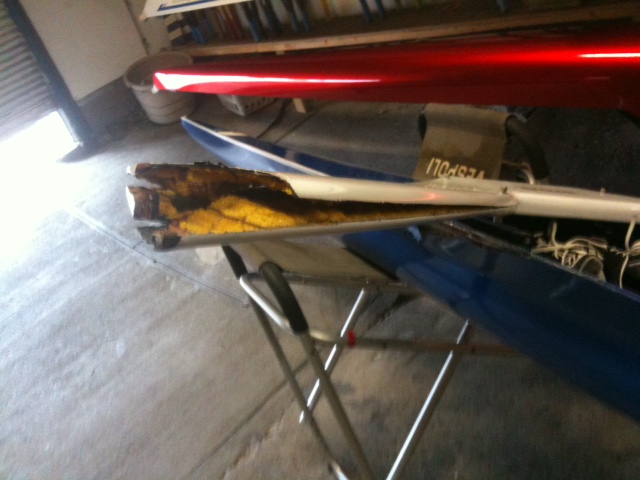
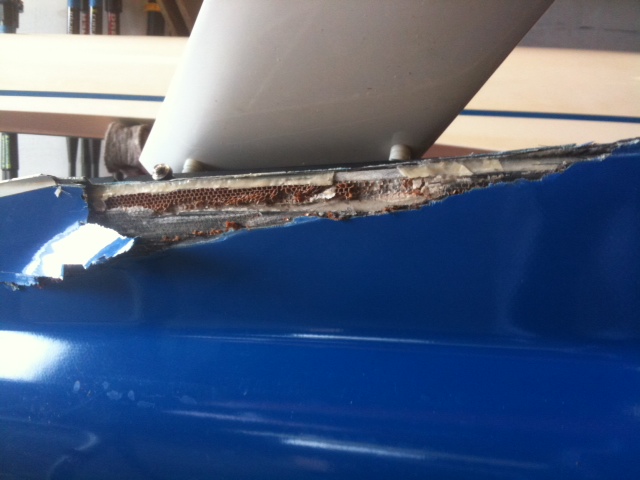
So it’s back to the bike, rehab, and lots of hopes & prayers. It could be worse – last year I was almost killed when I had a head-on collision with a Boston College varsity women’s eight, doing 3-minute pieces at full pressure and high ratings. I was up past CRI, where the Newton Yacht Club stands opposite a massive sand bar, allowing only a small channel in which to pass. I was looking into the sunset going upstream and, in so doing, turned around often to make sure no one was coming (knowing the dangers). I saw nothing, and I had polarized sunglasses on, so I would have seen a boat coming even with the glare. But there is a slight bend in the river as you approach the yacht club channel. After 5-10 strokes or so, I turned around again and there were two eights, going full blast, with a coach behind them. They were doing 3-minute pieces at high rating and full pressure, upping the rating during the pieces. The two eights were side by side and the one toward the middle of the river was coming directly at me. I would guess it was maybe 20 feet away. I’m not sure, but it was clear there would be a crash. I screamed in panic, “hold water,” but to no avail. They were hauling ass and there was no way the cox could have heard me. I had just enough time to take one hard stroke with my starboard oar and then another quick short stroke with both. Just as I was doing that second short stroke, WHAM!!! the eight hit my boat at an angle, just about where my foot stretchers are. Busted the Van Dusen wing rigger in half, tore the gunnel up pretty badly, and sent me into the river, which was cold but only thigh-deep, as I was on the sandbar.

It was all fixed and I was not seriously hurt, but… that was my training-delaying experience last spring. I can’t help but relive the experience from time to time – had I not turned around, that eight would have gone right through my back, and I’m not sure what the consequences of that would have been, except to say, not good. Maybe having a little tendonitis isn’t so bad by comparison?


Memoir – chapter 1

My dad was in Youville Hospital again. This is an old rehab hospital a few miles outside of Harvard Square in Cambridge, Massachusetts. He had been there the previous spring, but this time the call from my step-mother was more urgent. He was in bad shape.

I entered into the 1930s-40s time-warp that is Youville Hospital. The hallways had an unpleasant green color; the linoleum floor and fluorescent overhead lights gave a bleached but dim effect to the place. It was not like modern city hospitals, which are brightly lit, with comfortable, almost homey-feeling rooms. The worst part was that in every room, people looked like they were dying (many were, in fact, doing just that), and the hallway generally smelled of death and depression. Quite a few were on ventilators—machines invented to keep people alive no matter what, for those who had neither the foresight nor courage to sign “Do Not Resussitate” (DNR) orders.

When my dad had been here the previous spring, he was feisty. Very annoyed that he was uncomfortable and wasn’t getting the level of service or care he wanted. But for me that was good, as much as it pained me to see him so uncomfortable. It showed that he had fight in him. He had had so many “close calls” over the previous 10 years that it had become routine. Except that it wasn’t, because every time, I went through the whole emotional roller coaster of what was going to happen…would he live or die. So part of me numbed myself to the pain and part was in denial. The rest put on a smile and went there to be with him. After he recovered, however—during the summer, when I spent excessive amounts of “me” time, rowing, working, being there for my kids at home and dealing with my strained marriage—I was more in denial than usual. I avoided seeing him, and I had a sneaking suspicion that that was a bad idea, because there was something about his health that scared me. He was always frail, but he had signs of greater deterioration. The one time I visited him in his Longwood Towers apartment that summer, he was on a new enormous oxygen tank for his now-extreme case of emphysema. It wasn’t one of those fire extinguisher types—this tank was about half the size of a typical basement water heater. He had a long tube, which he dragged around the apartment. It was a nuisance, but he didn’t complain. He was all smiles as he sat at his kitchen table doing the crossword. I don’t even know what we talked about that bright sunny day. I just knew that he seemed much closer to death than ever before. He was so much mellower, slower, relaxed…and that was saying something, because he had become very slow, mellow and relaxed in his senior years—a big change from his “younger dad” years, when he was extremely temperamental, moody, domineering and enigmatic. I felt uncomfortable sitting there with him. He was in such bad shape but was so fine with it all. I left earlier than I should have, not being able to think of enough things to talk about, and I felt guilty afterwards. It was my only visit that summer. It was almost like I was waiting for him to die, after all the years of ups and downs. And the guilt of that was enormous, because I truly loved him and didn’t want him to die.

Toward the end of the summer, Libby, my step-mother, told me she had arranged a relatively minor operation for dad. With his oxygen needs now very great, it had become uncomfortable and almost dangerous for him to continue using the breathing apparatus through his nose. They had a procedure in which they’d cut a hole in his trachea and stick the oxygen tube directly into it. It would supply the oxygen more directly, reducing the amount needed and making him much more comfortable. Theoretically.

The problem was that the world-class surgeon at Brigham & Women’s Hospital in Boston didn’t quite get the size of the hole right. He cut a hole that was too big. The excuse was that dad’s trachea was much stronger and thicker than most, owing to his life-long passion for singing (he had been in a cappella groups since college). As a result, the tube didn’t fit properly and leaked. He had to have another operation to stick some kind of filler in there to caulk up the leaks. It sounded like a typical surgical snafu – a “routine” operation that had gotten all botched up.

By the time he was done with operation number two, it was Labor Day weekend, and he hadn’t eaten in many days. His body was starting to shut down. This is where it got interesting. According to Libby, the hospital where he was staying, Brigham & Women’s Hospital—one of the leading hospitals in the world and a Harvard teaching Hospital—“didn’t have the staff available” to provide dad with food intraveniously. I found that hard to believe, but I wasn’t in the decision-making process (I later found out from reliable sources that there’s no way this statement could have been true). So she inexplicably moved him to Youville.

Libby called me sometime the second week of September, after dad had been in Youville for over a week and was in very bad shape. This was the first I had heard from her since she told me about the operation in mid-August. She told me I had better come in soon—he didn’t have much time left. I had heard this before, but her tone sounded much different this time: much more urgent and frightening.

When I arrived, dad had full-on pneumonia, was on morphine and was on a ventilator. He was sleeping so I couldn’t communicate with him. He looked horrible—almost no life in him at all. I was stunned. I had no idea it had gotten this bad. Libby went through the whole explanation about the operation, etc, but I was numb. I talked to the doctor, a tall, gentle black guy, who told me dad was on what they called “comfort care.”

I had no idea what this meant.

I said, but wait, can’t you give him food intravenously?

He said, “That’s no use.”

This was incomprehensible to me. I asked, “What do you mean? Isn’t there anything you can do?”

“There really isn’t,” he responded, gently but directly. “We’re just trying to keep him as comfortable as possible.” He had done this many times before, and I suspect it was not his favorite part of the job.

It slowly sank in. I felt a flood of tears, combined with an ice-cold numbness that held them back, as I realized that dad was on as much morphine as he wanted to keep him comfortable. He was going to die and it would happen soon.

I asked how much longer, and the doctor said, “Maybe a week. It’s hard to tell.”

So here it was at last. All the close calls. All the times dad came back from near-death to defy all the odds. It wasn’t going to happen this time.

I went back home to call my sister and brother. My oldest brother Jay had died 10 months before, and I was the first to break the news to both my mom and dad. It was horrible, happening suddenly and without warning when his aorta exploded out of the blue as he sat working at his home office desk at four in the morning. I sat with dad in tears in his apartment, and he comforted me. I was so glad I was with him as I told him the news. Now I had to announce dad’s situation to Anne and Will. I told them that this was it—the real deal. They needed to get on a plane as soon as possible because there was no telling how much time he had left—maybe a week, but probably only a few days. They got a plane early the following morning, which just happened to be September 11th.

I went back to the hospital that night. Dad was awake but just slightly coherent. I looked at his eyes very close. He was barely there, but he recognized me. I told him I loved him and that registered. I told him Anne and Will were coming, and his eyes lit up. That was nice. After a bit, I got up to leave with Libby. Then dad did something I’ll never forget and which was quintessentially “dad.” He pointed to the TV—the Red Sox were on and he wanted to hear the game.

He died early the next morning, and I wasn’t there for it. I was so sad…I really wanted to be with him when he died. But I had my cell phone off, which was completely idiotic, and Libby either forgot or didn’t think to call my home number. It doesn’t matter in the long run—he was out of it, and he died comfortably. But at the time I was an emotional wreck, racing into the room hours after he had passed. I shut the door and cried as I held his cold arm, saying over and over “I’m so sorry Dad…I’m so sorry…” through my tears. They had removed his ventilator, so his mouth was in an open and contorted position. It was a horrendous sight and I could barely look at him. Libby, who had been a nurse all her life, was unphased by this image of dad – she probably looked at it differently…his soul was gone, so who cares what his corpse looks like? It makes sense to me, but at the time I could barely stomach her care-free attitude. Her closest life-long friends from her fancy Nantucket social circle showed up. They all seemed as happy as they could be. What in God’s name were they so happy about? It mystified me, but she and her Greenwich-Nantucket crowd had always set me ill-at-ease. They were beyond fake.

I didn’t realize it at the time, but my dad’s death, followed by my brother’s the previous November, would lead to the third event in what I now call my Mid-Life Trifecta, with the third event being the end of my marriage three months later.

RI Blog #20: Rowers Are Messed Up

Rowers Are Messed Up

April 3, 2009

Rowers are really messed up. We eat, breathe, dream and in all other ways consume ourselves with this sport. And it’s so unlike most sports that most people are into. There’s no ball or “thing” that goes into a “thing.” There are no picks (except the pick drill). There’s no passing, no blocking, no tackling, no hitting, no pitching, no catching — no hand-eye coordination of any kind involving an inanimate object. You sit on your ass and go backwards. And in doing so, you have an opportunity to win. That is seriously wacked. Like in the movie “Office Space,” where the guy’s fiancé makes him see a hypnotist because he’s so unhappy.

They’re sitting in the office, and Our Hero is describing his situation: “Every day is worse than the day before,” he says, “So every day…is the worst day of my life.”

“So is today the worst day of your life?” the hypnotist asks.

“Yeah,” the guy responds.

The hypnotist looks at him for a few seconds and says, “Wow. That’s messed up.”

So for me, it’s like, every day I care about rowing even more than the day before. So every day that I live, rowing consumes me more than ever. John “Skip” Dise, a young hot shot at my club whose locker is next to mine, summed it up perfectly yesterday, as we talked about workouts, etc. Being in the mode of “trying to get back into shape,” I think about working out more than ever…how often I do it, how many rows a week I log in, etc. So I was very pleased with myself that I had had a pretty brutal mid-day training session at my gym with my trainer (who is both hot AND an excellent trainer – great combination! It makes torture fun!), and I was finishing it off with a nice evening row. A rare two-a-day for me — which, since I’m turning 49 this summer, is something to be proud of. So Skip says, “After your row, you can join us for yoga and make it three workouts in one day. And just think,” he went on, “You could have one of those days where the amount of time spent working out takes up the majority of your waking hours. Those are the BEST days.”

He wasn’t kidding. He was completely serious. And I was in total agreement. When you go to bed totally aching from working out several times a day, those truly are the best days. There’s something very OCD about it. People like Michelle Guerette, Greg Ruckman, Steve Tucker, Linda Muri, and on and on…they attend schools like Harvard and MIT, discover rowing, and then, rather than going to Wall Street or starting the next Microsoft, they devote their entire lives to getting faster on the water. In a sport that will never, ever pay much money. Never. There’s just not enough broad-based interest in it (and let’s face it, rowing is not a great spectator sport for non-rowers – see above for the lack of throwing, catching, hitting, punching, and bloody noses). Every once in a while, someone will catch a crab and be projectiled out of the boat or have their nose broken, but those moments are way too few and far between for Joe Six Pack (or Joanne Six Pack) to want to watch people doing the same thing over and over and over for 5-7 minutes.

The great thing about rowing – or any sport like it – is that this passion can happen to anyone at any level. You don’t have to be an Olympian to have the Olympic-caliber OCD fanaticism for the sport. I suppose I’ve had other dreams at various times, but now, and for the past 25 years, it’s all rowing, all the time. Not a day goes by when I don’t think about it in some form. Did I row today? (In winter, did I work out today?) Being an athlete has become more important to me than anything else, and I’m fortunate to have many interests…writing, music, history, economics, investments, and even, at times, work! (I really hope my boss doesn’t read this.) And it’s not like I even work out that much. I’m up to like 5-6 times a week now. Not bad for this early in the spring. But not like my friend Sean Wolf who, at almost 39, still does 12-14 workouts a week (or so he SAYS! In any case, I know he rows twice a day, every day, so it actually does add up). But the thing is, I THINK about rowing or working out ALL the time. If I worked out today, it’s a good day. If I didn’t, the day is not complete. If I worked out twice, it’s a great day. If I spent most of my waking hours working out (very rare for me), well, as Skip says, those are the BEST days. Amen.

RI Blog #19: Now Is The Winter of My Content

Now Is The Winter Of My Content

March 3, 2009

I think it is fair to say that, from a fitness standpoint, this has been the winter not of my discontent, but of too much contentedness, as the title paraphrased from Shakespeare’s Richard III suggests. After a successful fall season, highlighted by a decent (though personally not up-to-par) showing in the Head of the Charles, and a surprising 2nd place at Silverskiff in Turin, Italy, I got very mellow. Very, VERY mellow. I came up with new excuses that staggered even my own vivid imagination. I finished my log book and needed a new one. And since I can’t work out without a log book, the month or so that it took me to buy a new one at the drugstore was filled with a sporadic, at best, workout regimen. In fact, “regimen” isn’t even an applicable word for it. I tried to take up running, buying new running shoes in November, under the assumption that coughing up a wad of cash would motivate me. It did – for about 4-5 grueling runs, which were more painful than I can begin to describe. I avoided the erg, weights, and even yoga – my usual three-pronged attack during the winter months.

What I discovered was…….sleep. Beautiful, Glorious, Slumber. Sleeping in late on Saturday and Sunday mornings has become such a thing of pleasure. I stayed up late during the week, watching Seinfeld at 11:30 PM. You have to love the two-Seinfeld night, once at 7:00 and then again at 11:30. I lazed around on weekends. Hell, I lazed around all the time. I did use my bike trainer – maybe half a dozen times this winter? – and that was okay. But really I just lavished in the luxury of doing a whole lot of…NOTHING. Ok I did some things. I watched a lot of movies. I spent a lot of time online (match.com kind of sucks, by the way). I brought “couch potatoing” to a new level. I figured, hell, I’ve been through a couple of really tough years, and I’m still going through a divorce (which will hopefully be finalized soon)…I deserve to be a complete and total slug. In late December, I finally got a new workout log. Early in its pages I decided to take my running shoes indoors (since there were mountains of snow outside) and run on the treadmill at my gym. On or about the second time of this experiment, I got a little overconfident on a four-mile run and decided to “crank it up” for the last quarter mile. Well, that effort ended in “cranking up” an injury to my left achilles tendon. Niiiccceee…. Fortunately, being older and wiser, and having had many debilitating injuries, I stopped all workouts, iced it for many days, and ate Advils like they were M&M’s – the standard routine for all “elite” athletes (HA! Had to throw that word in there for a good laugh at myself). Not only did this allow me to really slug it up (I counted no more than 5 workouts for the entire month of January), but it actually prevented a serious injury and healed the tendon quite nicely. My laziness was not only enjoyable, it had become practical.

At Riverside, my beloved rowing club, they have a winter event called the “Tri-WRATH-alon” which involves running half a stadium at Harvard, running back to the boathouse, and then erging for 8,000 meters – or something like that. I’ve never done it. Maybe some day I will do it, but not this winter! No, I have come up with my own brutal event. It’s not for the faint of heart. It’s the Official 2009 John Tracey “Tri-SLOTH-alon!” First, you sleep in on a Saturday morning…you get out of bed no earlier than 9:30 AM. Second, you roll into your sweats, stumble into the kitchen, turn on the coffee (both coffee and oatmeal have been pre-prepared the night before), have the usual oatmeal (with a ton of brown sugar, raisins and banana slices), and read something from a magazine or newspaper while listening to classical music. And finally, third, you sit on the couch, sip the glorious Peet’s coffee from your mug (Part III is a two-mug minimum), play on the computer, watch the morning news, and…just totally sloth it up. You only get up to take care of personal business (that’s all I will say about THAT), or to get the 2nd Glorious Mug of Joe from the kitchen. Part III is about 60-90 minutes in length. By 11:30-12:00, your day has gotten off to an amazingly wonderful beginning. Now it’s time to really kick it up a notch and find a good movie!

I hope this blog has been inspiring to all those who need an excuse to chill out. If you have any questions, please feel free to email me. I consider myself an expert in this newly developed field. I’m getting a Ph.D. in Winter Bliss. But watch out for me on the racecourse this season – I will be WELL RESTED!

RI Blog #18: Good Riddance 2008

Good Riddance 2008

January 14, 2009

2008 was an interesting year. Interesting in the sense of, you don’t want too many “interesting” years in your life. As the ancient Chinese curse states: May you live in interesting times.

In 2007, I had lost my brother (well, November of 06) and my father (September 07), and then my marriage ended a few days before Christmas. Without question, it was the worst year of my life. By January 2008, I was out of the house and living in a room at a B&B in the South End of Boston. I have never been more lost, lonely, or full of despair and hopelessness. I’m glad I still HAVE my life after all that. I made it my goal to try to “find myself” in 2008. But I didn’t really know what that meant. Who really can “find themselves?” I think it’s a life-long process. All I know is that I was completely stripped to my core, and I wasn’t just starting a new chapter in my life, I was starting a new volume. Volume I was over, and the book was shut forever. Volume II had begun.

As always, rowing was important to my existence. Rowing has given me hope, strength, friends, and support, not to mention the all-important physical and emotional outlets that are so vital for all of us. While I kept my personal issues close to the vest – I had a very small “circle of trust” that I relied on during the most brutal period from January through March – I still had my small circle of close rowing friends from Riverside Boat Club. These are guys I’ve had dinner with almost every week for the past five years. We have been through it all with each other, and we still get together and talk about rowing. And life. And women. And relationships. And everything. One of these friends lost his fiancé in 2008 to a brain tumor. She was a young, beautiful, brilliant, and very sweet friend to all of us. On the day she died, I found out that my cousin’s wife, one of my favorite people in our extended family, was in Mass General being treated for the exact same kind of brain tumor. SIGH. However, her will to live, without ever complaining about her condition, and his devotion to her (he never left her side for over a year), remain among the most inspiring examples for me. On a positive note, we’re all going to be in the wedding of another of our group – something that shows the circle of life…new beginnings. It’s awesome.

Death teaches us about life. It’s easy to say, you only go around once; you don’t know what you’ve got til it’s gone. Life is short. Blah blah freakin’ blah. But until you see your friend or loved one’s body, or your brother’s, or held your father’s in your arms an hour after he died, you don’t know just how short life really is. My brother dropped dead at 53, with no warning, from an aneurism in his aorta. I’m still in shock about it. I never got to say goodbye. But on the other hand, it was his time. No one has control over these things. I expect to live another 50 years and row the whole damn time, but even if I do, I know it will speed by in a flash. That’s why I don’t get stressed about things like work, or even a Harvard launch going through the wrong arch. A CRI or BC launch maybe… (kidding). My divorce will be painful for the rest of my life, but I have accepted that fact and I don’t let it rule me today. I feel relatively grounded and self-assured, but I am awed by the larger forces in this world over which we have no control. I love my apartment – it’s all mine, and I have made it my own. I love the location in Harvard Square, Cambridge, MA. I have a great relationship with my kids. My ex and I get along at a wonderfully superficial level, which is how it should be. But I have realized over this past year that really figuring out relationships, my place in the world, and finding true peace and spirituality deep within myself is a journey, not a goal. It’s not something you ever achieve, just something you strive for.

There are some specific goals I’d like to achieve this year…  getting Top 10 in the Head of the Charles in October 09; winning a few smaller races during the rowing season; finally having a decent race at Green Mountain in Vermont; traveling to some away regattas for fun – like maybe Oklahoma City or, if I can put together some speed, maybe Nationals. And of course, going back to Italy to try and repeat my performance of last November, if not improve on it. (I could write several blogs about my trip to Italy, and maybe I will – it was the greatest race I’ve ever been to in my life, and I got a silver in my age group to make it all the better.) I am really, really looking forward to finalizing a long, agonizing divorce. Of course, I’d love to make VP at work, but I’m not going to worry about that one…

As for relationships, I want to be realistic. I don’t feel I need to be in a relationship, but there’s nothing wrong with dating. However, to get into something really deep requires more progress. I’m still trying to get my bearings.

Like training for a race, I feel that the process of living your life is as much, if not much more, worthy than specific achievements. You go at it every day. Some days you kick ass and crush your opponents. Some days you give it your all and barely beat someone you never thought you’d be close to. Some days you give everything you have and come up short, but you still feel good because you gave it your all. And other days, you feel like shit…you’re tired and weak. So you just head home and rest up and hope that things improve the next time.

Life is about progress, not perfection. And the only way I know is to take it a day at a time.

Thanks to all who have read my blogs and given me some great feedback. Thanks to my good friend Sean who started this site and worked his ass off to get it up and running. I really love contributing to it, and it has helped me immensely.

So… back to the grind for 2009. Peace, happiness, and above all, FUN. There’s no enjoyment without some good laughs in this world. Let’s row our asses off but have a great time doing it.


RI Blog #17: Thanksgiving

Blogger’s Note: This is not about rowing. 

November 25, 2008

This is a little story I wrote in response to an email to the Riverside Boat Club List from the famous British rowing coach, David Martin, who had mentioned that he didn’t fully understand what “Thanksgiving” was all about. Hope it lightens up your holiday season a little.

-JT

*************************************************************************************

Dear David,

Thanksgiving is one of the truly American holidays, so it’s no wonder you don’t understand it (you freakin’ Tory Monarchist you!!!).

Ok so here’s the basic rundown. About a hundred & fifty years before George Washington and his fleet-footed generals kicked your ancestors’ and the Hessian Huns’ asses by forcing them to chase our guys all over North America wearing heavy wool red uniforms (RED?? Choose another color dude! That’s an easier target than they have in Junior Archery class!), a group of religious fanatics (the “Saints”) and a bunch of other bounty hunters and/or otherwise bored or criminal Englishmen (dubbed “Strangers” by the Saints), decided to make a perilous journey across the Atlantic Ocean to seek a new life. Being poor and unwanted, they could only afford a pathetic, way-too-small ship that someone called the “Mayflower,” and stuffed it with themselves and a bunch of disgusting animals (inspiring the idea of “stuffing”), and somehow, miraculously, made it across the “Pond” (sarcastic term coined by one of the Strangers for the harrowing North Atlantic). Unfortunately, they landed in New England, home of the Worst Climate on the Face of the Earth.

Anyway, the rag-tag bunch, along with the Holier Than Thou Religious Freaks, landed on the Cape, saw a bunch of beached whales, and were spied by the Native Landowners. Not wanting to settle on a bunch of cold sand, and terrified of the near-naked Natives, they continued on and found a cozy Rock somewhere near Route 3 South, right in the middle of construction of the Southeast Distressway. Fortunately, the Cape traffic was light that day, so they decided to make this their home. The Strangers went off into the woods, made friends with the Natives, introduced them to Johnny Walker Red, had a ROCKING good time, and probably did a little plundering on the side. The Saints struggled to clear the land, move all the rocks, and try to grow something amidst the cold, sandy, non-fertile soil. They were able to build some crude huts, but nothing grew and about half of them died that winter, freezing their asses off (their fronts, facing the fire, were fine, but their asses, facing away from the fire, literally froze OFF). Because they had outlawed Sex, they were not allowed to keep each other warm “the old fashioned way.” From this experience they developed a new Protestant religion called “Puritanism.” Ironically, they had come to the New World seeking religious freedom. But after they invented “Puritanism” – defined as “The Haunting, Terrifying, Unacceptable Notion that Someone, Somewhere out there is Having A Good Time” – they immediately closed ranks and became the Most Religiously Intolerant People Ever in Recorded History, putting any disbelievers into these new, funky devices called Stockades. (A “stockade” was like a mini guillotine with no blade. Your head and arms would stick through the holes so the people walking by could tweak your nose, stuff sand in your ears, kick you in the ass a few times, throw rotten eggs at you, and do any other acts of their choosing – known to the Puritans as “amusement.”) Interestingly, Puritanism lives on in New England almost 400 years later, but its definition has changed to mean, “You don’t deserve anything GOOD in this life unless you have really, REALLY suffered for it.” See the Red Sox, our rowing club’s policy for initiating new members, Boston weather, and many other 21st century examples.

SO. Where was I. Oh yeah, Thanksgiving. So after the first year, in which they had suffered Unmentionable Sufferings and still couldn’t figure out how to grow even a houseplant, they headed into November, cold, tired, and very discouraged – even Puritans could get a little down sometimes. But it was all God’s Plan, and still, this plucky group kept their Faith. And Faith was restored to them, because fortunately, down South in Jamestown, a young English Stud named Captain John Smith (not his real name – one of many aliases he used to avoid being captured for violating Puritanism) had hooked up with a gorgeous Native named Pocahontas. This incredibly romantic meeting – filled with more good sex than can ever be described in a Family Friendly Website Like This – paved the way for an era of Detente between the Natives and the “Whities” throughout North America.

As a result, the Natives of New England decided to share their enormously vast stores of food (after thousands of years living in New England, they had figured out how to grow stuff), including the old favorites, Turnips, Ocean Spray Cranberry Sauce, the previously mentioned Stuffing, and a new, accidentally invented (on a soggy September day) food called Kellogg’s Corn Flakes. Sir Kellogg, a Saint who said “F-this” and became a stranger upon arriving to the New World, became the richest man in America as a result of developing a new food called “cereal.” And thank God he did, because it’s still my favorite food.

So they had a Great Feast on the Last Thursday in November. Drinks were drunk, the Puritans even smiled a little, everyone ate a ton of food, and a New Era of Peace and Prosperity was declared by both the Natives and the Pasty White Freakazoids. After the Great Feast, they retired to the Native Chief Massasoit’s Grand Mansion and watched the Cowboys play the Lions on his entertainment center. Thanksgiving, the Greatest American Holiday, was born. The Puritans were so grateful, they gave the Natives these really cool blankets. Unfortunately, the blankets had some weird virus in them called “Smallpox,” and many of the Natives died soon afterwards. But the Puritans soldiered on, stealing the Directions for Growing Food from the Natives, and went to church faithfully every Sunday. They wrote inspiring hymns such as “Amazing Grace” and “Die You Heathen Ingrate, DIE!!” and produced such Luminaries as Increase Mather, and his even more amusing son, Cotton Mather. Between the two of them, they were responsible for some of the greatest American Institutions of All Time – notably, Harvard University and the Salem Witch Trials. As the latter was responsible for the founding of Yale University, it is widely believed that the co-mingling of these great institutions resulted in the annual Harvard-Yale Boat Race.

And the rest, as they say, is history.

100% of this is true. It has to be – I got it from Wikipedia. I hope this has been helpful.

Peace, Love, and a Happy Thanksgiving to All.